In collaboration with Marielle Burt, Alyssa Li, and Ada Zhou.
This game was developed during Stanford University’s CS 377G (Designing Serious Games). In a 2-week time frame, my team went through numerous rapid iterations: we developed low-fi, med-fi, and high-fi prototypes, and conducted 5 playtests throughout the development process.
Overview
Since Roe v. Wade was overturned, access to abortion care has become severely limited and illegal in many states, and abortion clinics face new, complex barriers to providing vital care. Abortion clinics must strategize to navigate these restrictions, which vary drastically from state to state, while also advocating for a future where abortions are more safe and accessible.
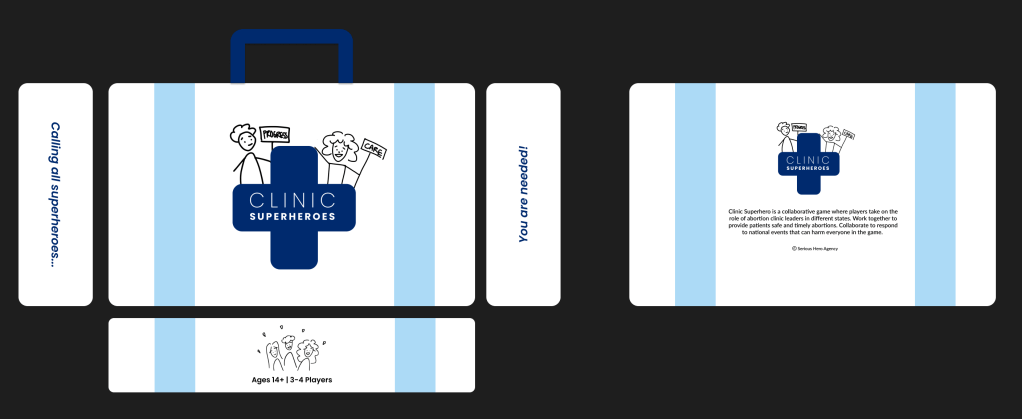
Clinic Superheroes is a collaborative game where players take on the role of abortion clinic leaders in different states. Players work to provide their patients safe and timely abortions while collaborating with other abortion clinics to respond to national events that further restrict abortion access. This experience is designed to provide players a deeper understanding of differences in abortion care across states and inspire them to advocate for more equitable abortion access.
Clinic Superheroes is a game for 3-4 players, high school age and up. We designed the game with the hope that it could be shared in high school sexual health classes, college clubs where people have an expressed interest in learning more about abortion care, or in a casual table-top game night.
Our design choices seek to elicit several different types of fun: challenge, fellowship, and narrative. Clinic Superheroes is an intentionally difficult game, reflecting the reality of barriers to abortion access. Through strategy and collaboration, players are able to overcome these challenges. Moreover, the collaborative structure of this game is intended to build a sense of fellowship between players that will help them understand the value of community in working towards broader abortion access. Finally, the narrative elements of the game, such as helping patients, dispelling protesters, and gaining supporters add a level of pathos to game play.
Final Deliverables
Figma of Game Components
More details on class blog post.
Rulebook
Game Components
9 Boards
- 4 Player Boards (Protected, Unprotected, Hostile, Illegal)
- 4 Protestor/Supporter Placemats
- 1 National Board
- 1 Served Patients Placemat
176 Cards total
- 90 Resource Cards
- 20 each of Appointment and Procedure Cards
- 10 Abortion Pill Prescription Cards
- 8 Aftercare Cards
- 3 each of Special Resource Cards (Anonymous Donation, Education Campaign, Doula, Grant, Pro-Choice Rally, Expand Contraceptive Access)
- 9 Dispel Protestor cards
- 72 People Cards
- 30 Patients
- 24 Protestors
- 18 Supporters
- 10 Bad News Cards
- 4 Player Cheat Sheets
Other Materials
- You will need 1 fair coin for coin flips (not provided).
Assessment
Our three core learning goals for Clinic Superheroes are:
- To increase empathy for abortion clinic workers and people seeking abortions.
- To deepen players’ understanding of core differences in abortion access across four types of states (illegal, hostile, unprotected, and protected.)
- To help players to learn more about different ways to advocate for and support individuals seeking abortions.
The game design specifically targets each of these goals. By inviting players to take on the role of abortion clinic workers, the game helps build empathy for the difficulty of this experience. As players work together while following specific restrictions for their state, the game creates an opportunity for players to talk about the differences in care in the four different types of states. Several mechanics help players learn about abortion advocacy: the dispel protestor cards prompt players to recite text that explains why abortions should be protected, the support cards describe real-world actions and events that positively impact abortion clinics, and the bad news cards describe potential real-world events that negatively impact abortion clinics. Finally, we included a set of reflection questions to inspire deeper conversation about abortion access after gameplay.
In our final two playtests, emphatic reactions from players suggested that our game successfully produced our desired learning outcomes. Players talked about their clients with a sense of care and concern, making remarks such as, “We have to save Maria!” and “I need to treat Susan first, she has been waiting for so long!!” Similarly, players were united in their frustration with bad news events that harmed all abortion seekers, audibly wincing or proclaiming, “Oh no!” when a new bad news event was revealed. Even when the players won the game in our last play test, they decided to keep playing because they wanted to help as many patients as possible.
Players also expressed that they learned meaningful information about abortion access. Many players expressed a deeper knowledge about the inequity of care in different states. One player remarked that the game clearly communicates the time pressure of providing an abortion quickly, and that they understood more about how providing this care becomes more complicated later on in a pregnancy. The most important takeaway from the game seemed to be an understanding of the value of collaboration in expanding abortion access. Several players made comments about how the “us vs. the game” structure provided a strong parallel to our political reality.
 Home
Home 