Solo project.
This game was developed during Stanford University’s CS 377G (Designing Serious Games) in a 3-week time frame.
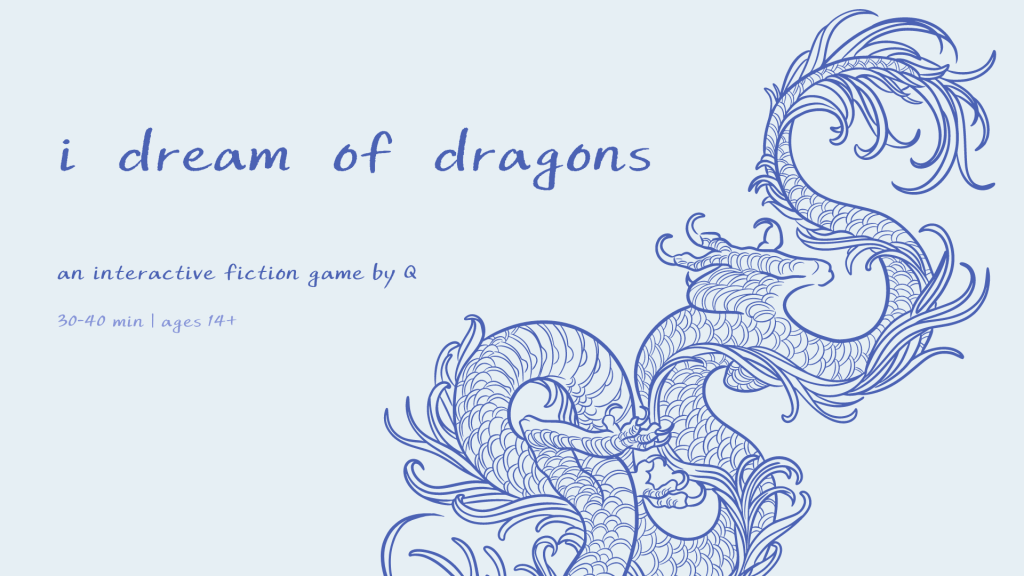
Premise
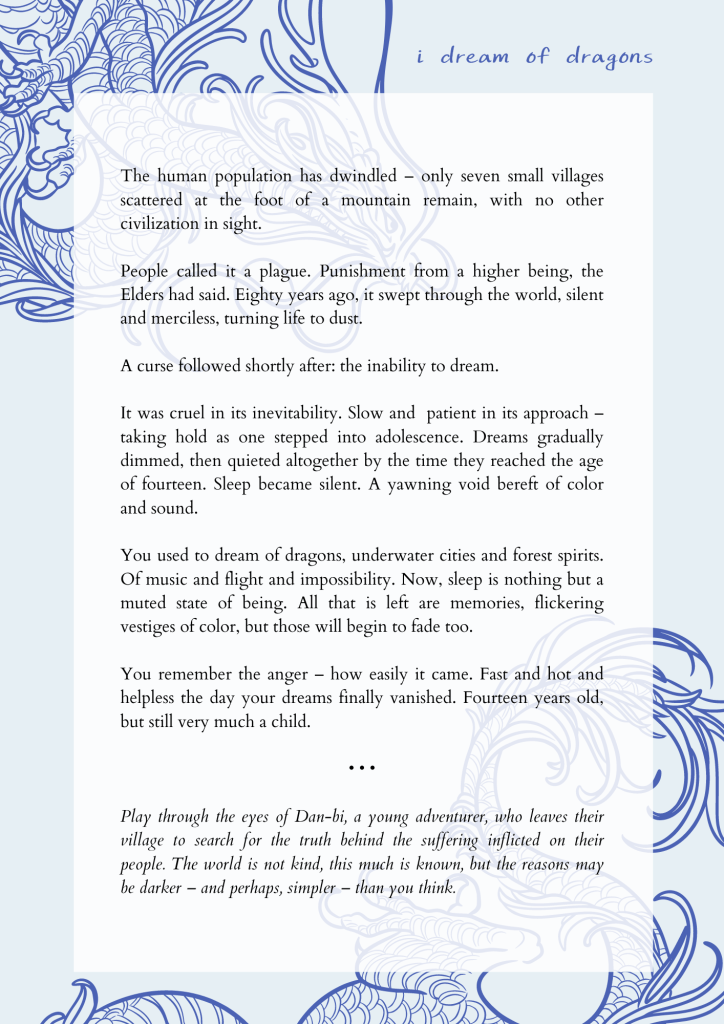
Process Details
This section contains spoilers. Playing the game before reading is recommended. 🙂
Ideation
During quarantine, I rediscovered my love for fantasy and fiction through video games, and got knees-deep in fandom culture, fanfiction writing, and world-building. I spent a lot of time daydreaming, which was something I had not done freely since I was much younger. Subconsciously, I had internalized things that others had either explicitly told me or implied – that daydreaming, reading fantasy/fiction, and engaging in nerdy fandom culture was “childish”, “foolish”, and “a waste of my time”.
When I do have them, my dreams and daydreams are always extremely vibrant, dystopian, fantastical and highly unrealistic. But as I grew older, I always attributed some subconscious form of guilt or shame to them, thinking that I was “too old” to be living in my imagination. At some point, I had internalized other people’s negative perceptions of dreaming and imagining fictional worlds so much that there was a period of time where I stopped dreaming altogether.
I didn’t realize I was mourning this loss until I rediscovered that side of myself through video games, fantasy books, and animated films during quarantine, and I realized how foolish it was of me to lock away that part of me in the first place. So I decided to write a story about this process of growing up and losing a defining characteristic of my childhood, as well as the relief and beauty in its rediscovery.
Terms + Naming Significance
I wanted to incorporate a bit of my own culture in terms of naming the characters. All character names, village names, and other game-unique terms are romanized versions of Korean words.
Though the names of all the villages are not explicitly stated, each of the seven villages is named after one of the seven deadly sins.
| Village Name | Meaning | KR | Pronunciation |
|---|---|---|---|
| Kyo-man | Pride | 교만 | gyoman |
| Na-teh | Sloth | 나태 | natae |
| Seg-yok | Lust | 색욕 | segyok |
| Sik-tam | Gluttony | 식탐 | shiktam |
| Bun-noh | Wrath | 분노 | bunnoh |
| Jil-tu | Envy | 질투 | jiltu |
| Tam-yok | Greed | 탐욕 | tamyok |
Additionally, each character’s name is significant, and the meaning of their name is intended to complement the meaning of their assigned guardian’s name.
| Character Name | KR | Meaning | Role | Description |
|---|---|---|---|---|
| Dan-bi | 단비 danbi | Long awaited rain, spring rain, timely rain | Main character | 22 years old, gender neutral |
| Ho-su | 호수 hosu | Lake | Dan-bi’s guardian | ?? years old, gender neutral, blue-white dragon in spirit form, elderly woman in alternate form |
| Bit-na | 빛나 bitna | Shining | Catalyst for Dan-bi’s journey in Ch. 0 | 14 years old, female |
| Yi-sul | 이슬 eeseul | Dew | One of the San-ai in Ch. 2 | 20-22 years old, male |
| An-ghe | 안개 angae | Mist, fog | Yi-sul’s guardian | ?? years old, gender neutral, a large phoenix-like bird |
| San-ai | 산 아이 sanai | Mountain child | Term for the children who were born and raised in the mountains |
Reflection
The main points of feedback from my first draft was that the player did not have enough agency in the choices they made and that they didn’t feel consequential. This made sense since I struggled a lot with creating a story for a player as opposed to a reader, and it was make that shift from a writer to a “narrative architect”.
I felt that I put in some trivial choices for the player to make, just for the sake of giving them choices. I still struggled with a lot of this in the current draft – I think the structure and narrative of my story progresses very linearly to build understanding and history, and the majority of the consequential choices come towards the latter half of the last chapter. During the final playtests in class, I received some good feedback from my instructor and two of my playtesters of locations to insert more explicit player choice. My instructor advised not to be too caught up on making everything so obviously consequential (one playtester said that seemingly trivial choices can reveal more about the character and the story, which thus makes it a non-trivial choice).
I would love to continue working on this game and work in more choices in the beginning so that the reader has even more agency over the story. I still have a bit of trouble departing from the idea of “I want the story to end like this” and “I want the events to progress in this order” and succumbing my control to the reader, but I think continuing to work on this story will teach me a lot of good lessons in designing games in general.
I had a lot of fun working on this story and being given the chance to refine it further. Creative writing is something I love doing in my free time, but it’s hard to do during the school year, so I was very grateful for the chance to do it for a class.
 Home
Home 